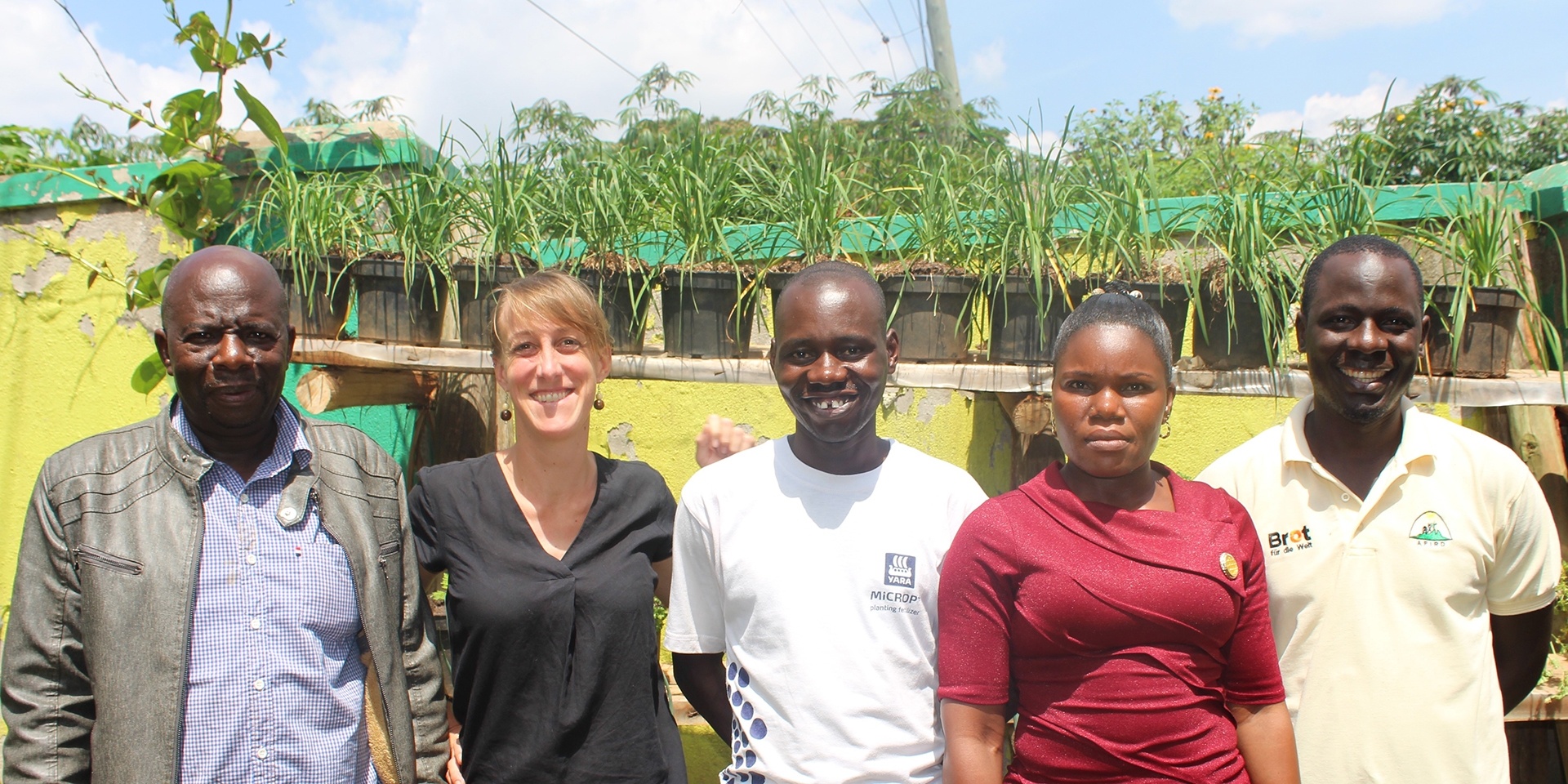
Photo: Kirembe Gerald, Renée Moreaux, Haumba Michael, Namaganda Jackline, Wasswa Faizo
Improving of the livelihood of Ugandan farmers on an ecological, economic, and social level. The project cooperation works on AFIRD’s organisational impact to increase the NGO's potential for the sustainable implementation of its projects. Moreover, the establishment of a social enterprise is strengthened, which is AFIRD’s sister institution Resource Center for Permaculture. The centre offers trainings and organic agricultural inputs to farmers, gardeners, and institutions.
As landscape ecologist, Renée Moreaux has been working for several years as project coordinator and consultant in the context of sustainable use of natural resources, conservation agriculture, and protected area development. She specializes in participatory facilitation methods at the intersection of sustainable land use and international conservation.
The advisory assignment focuses on strengthening the organizational development of the Agency for Integrated Rural Development (AFIRD) in Uganda. The assignment enhances AFIRD’s impact by improving its internal structures, refining management systems, and increasing efficiency in project implementation. A core component is the establishment and business development of the Resource Centre for Permaculture (PRC) in Nkoowe, which provides training and organic agricultural inputs to farmers, gardeners, and institutions. Additionally, the advisor supports AFIRD in advocacy and public relations, ensuring broader outreach and engagement with stakeholders.Key activities include capacity-building sessions and coaching for AFIRD’s leadership and project teams, strengthening project management, resource mobilization, and business strategy development for PRC. Regular coordination meetings facilitate continuous progress monitoring and strategic alignment. The advisor also plays a critical role in streamlining organizational structures by refining staff systems.Further, the assignment supports AFIRD’s human resources and financial management by mainstreaming staff guidelines, recruitment policies, capacity-building frameworks, and salary structures. Strengthening AFIRD’s network with like-minded organizations in Uganda is another essential aspect, enhancing collaboration and knowledge-sharing. Through these measures, the assignment contributes to AFIRD’s long-term sustainability, ensuring that Ugandan farmers experience improved ecological, economic, and social conditions.##sdgtargets## 2.4;8.3;12.2
Key activities include capacity-building sessions and coaching for AFIRD’s leadership and project teams, strengthening project management, resource mobilization, and business strategy development.