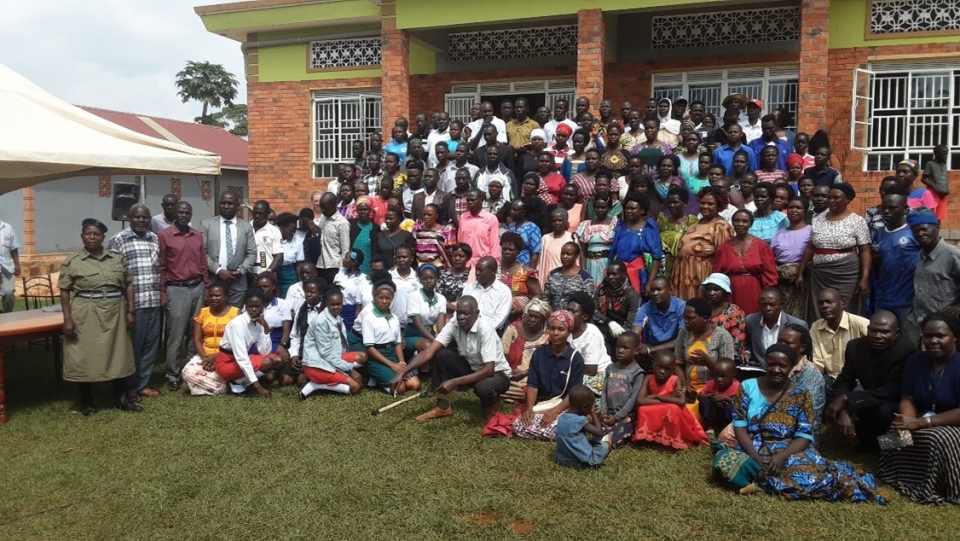
Transforming Gender Roles in Households Through Male Champions

Topic: Gender Equality
Gender Equality
East Africa
Learn&Share: knowhow3000

Problem & Solution

Women in rural farming households carried most domestic and care responsibilities while also contributing substantially to agricultural production. This limited their participation in training, leadership, and economic opportunities. Traditional gender norms often restricted shared decision-making and reinforced unequal roles. Dependence on traditional cooking methods further increased women's workload and exposure to harmful smoke.

To address these issues, YARD trained respected male farmers as Male Champions who promoted positive masculinity, shared household responsibilities, joint decision-making, and labour-saving technologies. Through practical examples and peer learning, they encouraged wider community behaviour change.

The Experience

  • YARD collaborated with a farmers' cooperative to identify gender-related barriers affecting women and household wellbeing. Community members helped identify respected male farmers who could serve as role models.
  • Selected Male Champions received training on gender equality, positive masculinity, household cooperation, and sustainable livelihood practices. They reflected on existing norms and explored alternatives that benefit both women and men.
  • Using Gender Action Learning Systems (GALS), champions facilitated discussions within households. Couples analysed how responsibilities, resources, and decisions were shared and developed practical actions for change.
  • Families tested new ways of working together, including sharing domestic tasks, improving communication, and adopting labour-saving cooking technologies that reduced time and effort.
  • Champions shared their experiences through meetings, demonstrations, and peer exchanges. Their visible changes encouraged other households to adopt similar practices and start discussions about gender equality.
01

Challenges

01

  • Deeply rooted beliefs assigning household work primarily to women.
  • Resistance from some men who viewed changing gender roles as a threat to established norms.
  • Limited access to labour-saving technologies in some communities.
  • Need for continued follow-up to sustain behaviour change.
02

Impact

02

  • Reduced workloads for women through more balanced sharing of household responsibilities.
  • Improved communication and joint decision-making within families.
  • Increased participation of women in farmer group meetings and livelihood activities.
  • Greater appreciation among men for unpaid care work and shared household responsibilities.
03

Lessons Learned

03

  • Community testimonies motivate other households to adopt similar practices. 
  • Household dialogue strengthens trust, communication and joint decision-making
  • Practical demonstrations are more persuasive than theoretical training alone. 
  • Labour-saving technologies provide an effective entry point for discussing gender equality. 
  • Continuous mentoring is essential for sustaining behavior change. 
Realisation period 2025–2026
Location ,

Partner organisation - Youth Association for Rural Development (YARD)

Youth Association for Rural Development (YARD) was founded in 1995 to provide knowledge and skills to needy youth, women, and children for improved livelihoods. The organisation is operating two vocational schools for youth and farmers.

Your choice regarding cookies

This website required cookies in order to function. Technically required cookies stored locally do not collect any personal data. Further technically required cookies are stored by the providers of third party applications.
Additionally, non-essential cookies are collected for analytical purpuses.

You can find out more by visiting our cookie policy linked below.