07.10.2026
GROOTS Kenya
Engaging Men as Allies in a Grassroots Movement Led by Women
Problem & Solution
Patriarchal norms, discriminatory practices and unequal power relations limit grassroots women’s and girls’ leadership, participation in decisions, and access to and control over resources. They also contribute to gender-based violence and the unequal distribution of unpaid care work. Organising women and girls is central to GROOTS’ approach. Lasting change also requires engagement with men and other community actors who influence household and norms.
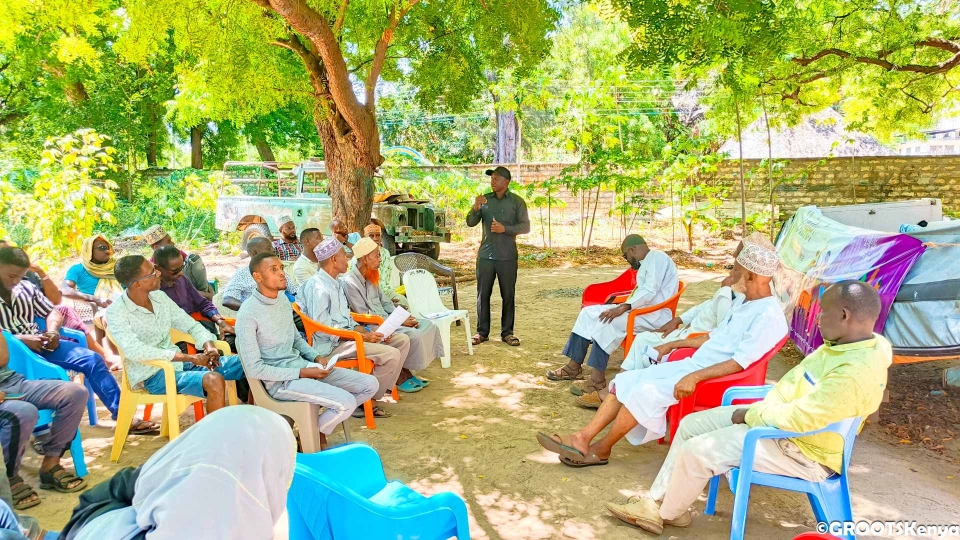
GROOTS addresses this through its women-led champion model. Men for Women Champions are male allies who have demonstrated a commitment to women’s and girls’ empowerment. They engage other men in dialogue on women’s rights, equitable decision-making, shared responsibilities, and women’s leadership. Male engagement complements women’s collective organising; women and girls remain central to setting priorities, leading action and holding the process accountable.
The Experience
- Community mapping and listening sessions identify women and girls who are excluded, the barriers they face and the priorities they want to address.
- Orientation and capacity strengthening help women and girls understand their rights, organise collectively, develop solutions and influence community and public decisions.
- Women-led groups jointly analyse problems, develop responses, engage responsible authorities and track change.
- Women-led groups and emerging champions receive mentoring, peer learning, targeted capacity building and, where useful, learning visits from experienced champions.
- Local administrators, public institutions and community leaders are engaged to create space for women’s priorities and strengthen coordination and responses.
- Champions are selected for their demonstrated commitment to women’s and girls’ empowerment. They engage other men through dialogue and sensitisation on harmful norms, women’s leadership, equitable decision-making and shared care responsibilities. Religious leaders, cultural leaders and other trusted community actors may help adapt discussion to local realities, while the agenda and leadership remain with women and girls.
- Continued dialogue, mentoring, monitoring and accountability are used to support change beyond one-off activities.
Challenges
- Resistance rooted in patriarchal norms and unequal power relations requires sustained engagement.
- Male engagement can shift attention or authority away from women if roles and boundaries are not explicit.
- Public statements of support do not always translate into sustained behaviour change in households, organisations or communities. Weak selection, safeguarding or accountability can give influence to allies whose behaviour does not match the values they are expected to uphold.
- Cultural, religious and socioeconomic contexts vary, so the same dialogue or engagement method will not work everywhere.
Impact
- Male champions carrying women’s priorities to male peers and helping reduce suspicion about women-led organising in h3-supported policy dialogue work.
- Male allies supporting women’s participation in leadership, land governance, policy dialogue and community decision-making in documented cases.
- Stronger engagement between women-led groups, public institutions and other community stakeholders.
- Results should not be attributed to male engagement alone but the combined work of women’s organising, champion mentoring, stakeholder engagement and male allyship.
Lessons learned
- Begin with women-led analysis, define the role of male allies in relation to women’s priorities.
- Select Champions on demonstrated commitment, and use safeguarding, feedback and accountability processes throughout.
- Equip facilitators to challenge harmful views without allowing dialogue to become unsafe or to displace women’s voices. Use trusted local structures while protecting women’s leadership and decision-making power.
- Measure change through behaviour and shifts in decision-making at household, community and institutional levels, not attendance or stated intentions alone.
- Document setbacks, differences between locations, and the specific contribution of male engagement. Maintain repeated dialogue, mentoring and follow-up because gender transformation takes time.

